The story
Why GRIT exists
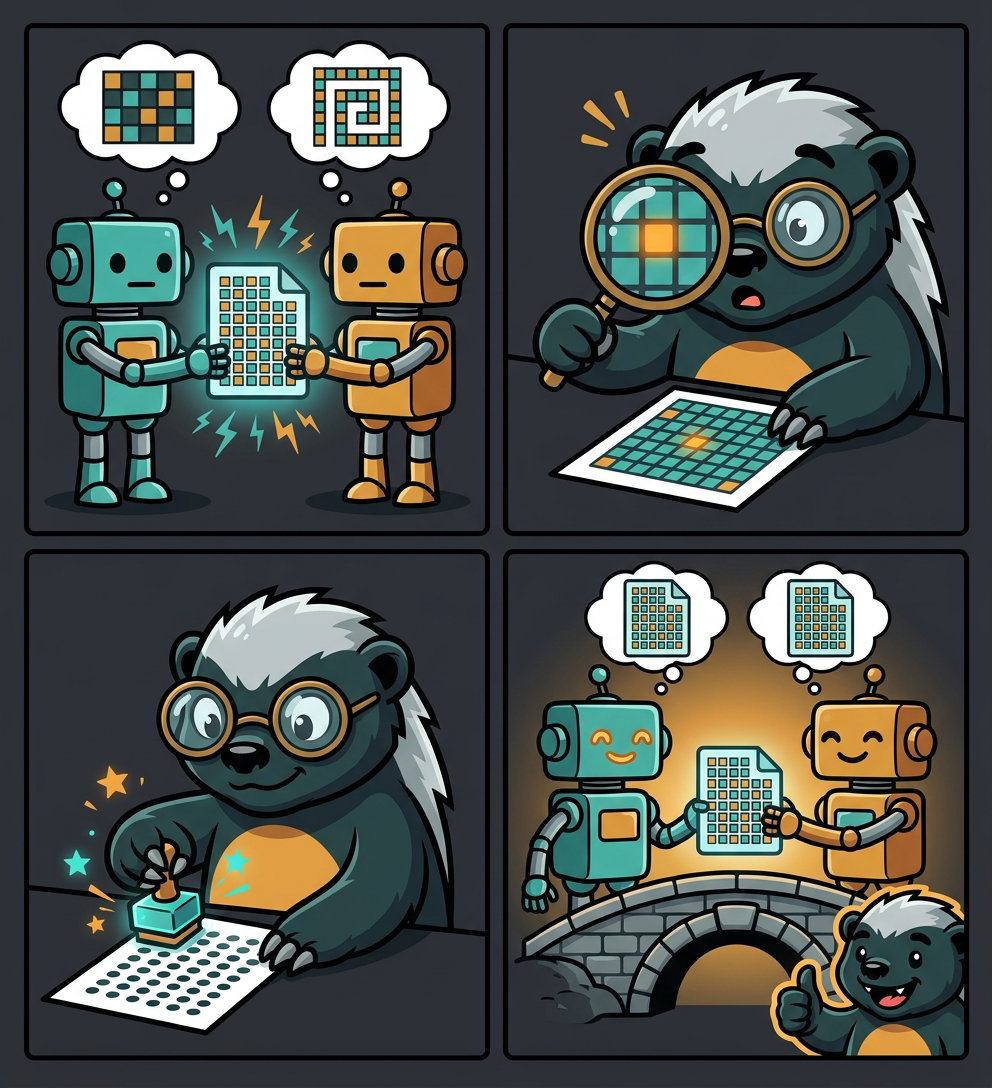
It started with a simple question: when a quantized checkpoint moves between two tools, what, exactly, promises that both sides decode the same numbers?
The answer, we found, is nothing. The formats that carry today's quantized models — GGUF, safetensors — record shapes, dtypes, and byte offsets. They do not record the decode semantics: which shared-exponent rounding the producer used, whether a zero-point is stored as-is or minus one, how scale planes interleave with data. Those decisions live in the source code of whichever tool wrote the file. Change tools, and you are trusting that two codebases independently made the same undocumented choices.
So we downloaded four real, popular checkpoints and read them byte by byte. In a corpus of just four files we found a GGUF whose declared file type disagreed with what the tensor bytes actually were, and two quantization families whose serializations are byte-identical at the container level while their decoded values differ — the file itself cannot tell you which numbers it contains.
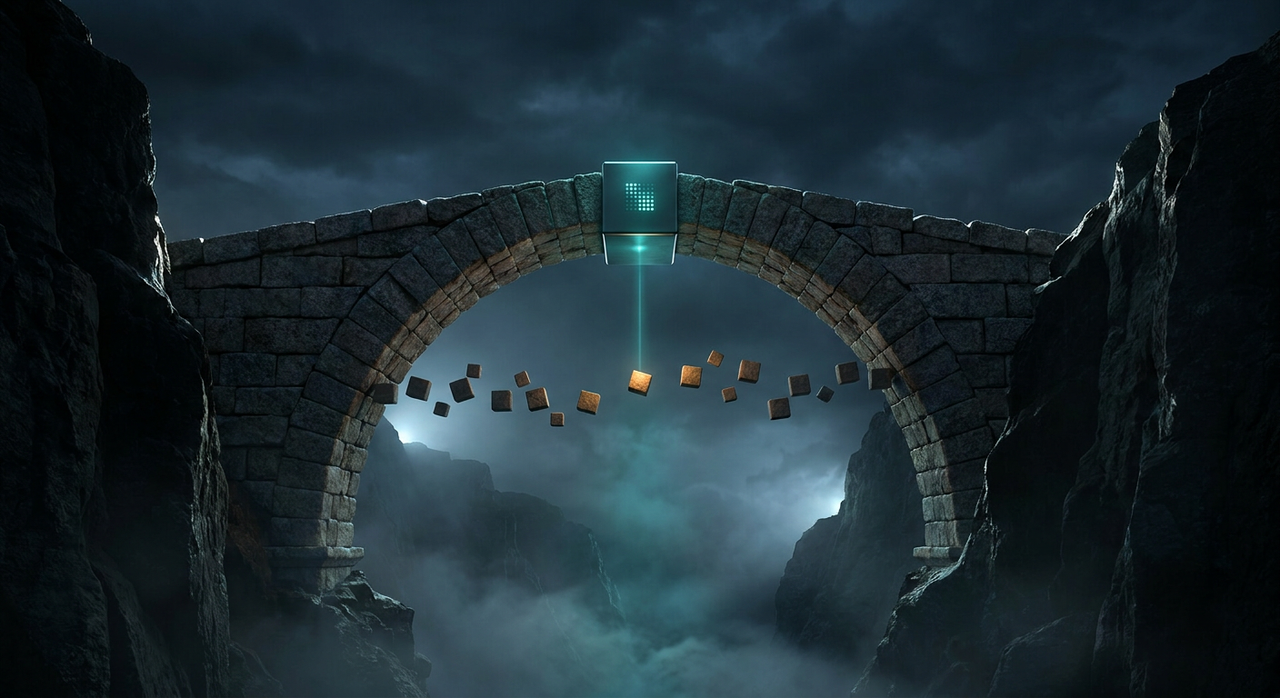
GRIT is the smallest fix we could specify completely: a grade — a canonical string that pins every decode decision — compressed into a 64-byte descriptor a producer writes once and a consumer checks in constant time. No new container, no re-encoding, no server. And because nobody emits descriptors yet, GRIT ships grit scan: a read-only auditor that applies the same discipline to the files you already have, today.
The claim is deliberately narrow and fully verified: one spec, five implementations in five languages, 68 conformance vectors, and a cross-language identity check that agrees 96/96 — all reproducible from a clean checkout.
How we decided to do what we do
A rule, before a line of code
GRIT did not start as a product idea. It started as a dare: find something genuinely missing — and only build it if the gap survives an adversarial attempt to prove it already exists.
So before writing anything, we swept the landscape and tried to kill our own idea: MLIR's sub-channel quantized types, StableHLO's DotAlgorithm, compressed-tensors, Avro's canonicalize-then-fingerprint discipline, the Khronos Data Format Specification, DLPack, torchao, TOSA's block-scaled types. Every claim of novelty had to survive a review panel whose explicit job was to refute it. What didn't survive was retracted before it was ever published — the spec's own claims table names the closest prior work for every component, because a contract type that oversold itself would be its own counterexample.
What survived the sweep was not a format — formats abound. It was the absence of a contract: nothing at any producer–consumer boundary checks that two tools mean the same thing by the same bytes. That decided the shape of everything: a checkable type, not another container.
The second decision was method. GRIT is built by a human–AI team working in the open: singhpratech sets direction, constraints, and the standard of evidence; Claude (Anthropic) does the orchestrated heavy lifting — five implementations written and cross-verified, an exact-arithmetic oracle sweeping tens of thousands of float values against every encoder, and a three-reviewer hostile panel that attacked the paper before anyone else could. The working rules never changed: every number must regenerate from a clean checkout, and every reviewer finding gets fixed or documented as a limitation — never softened.